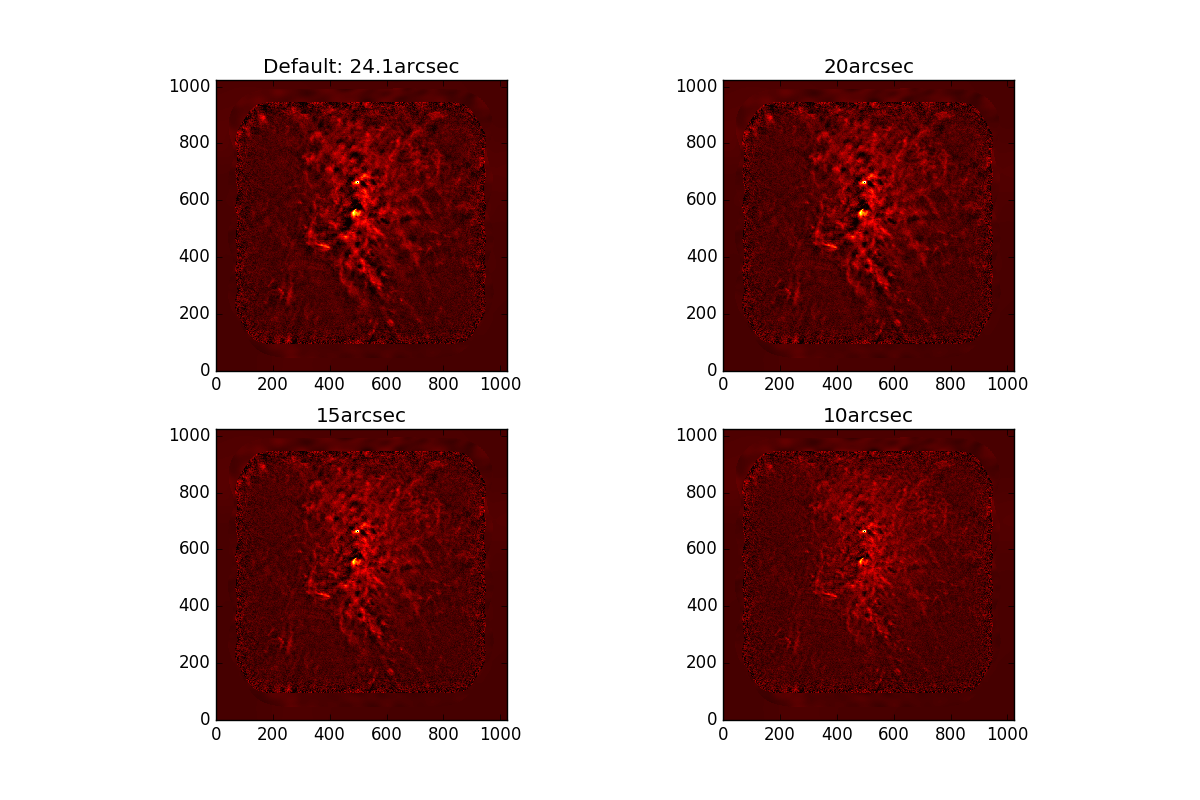
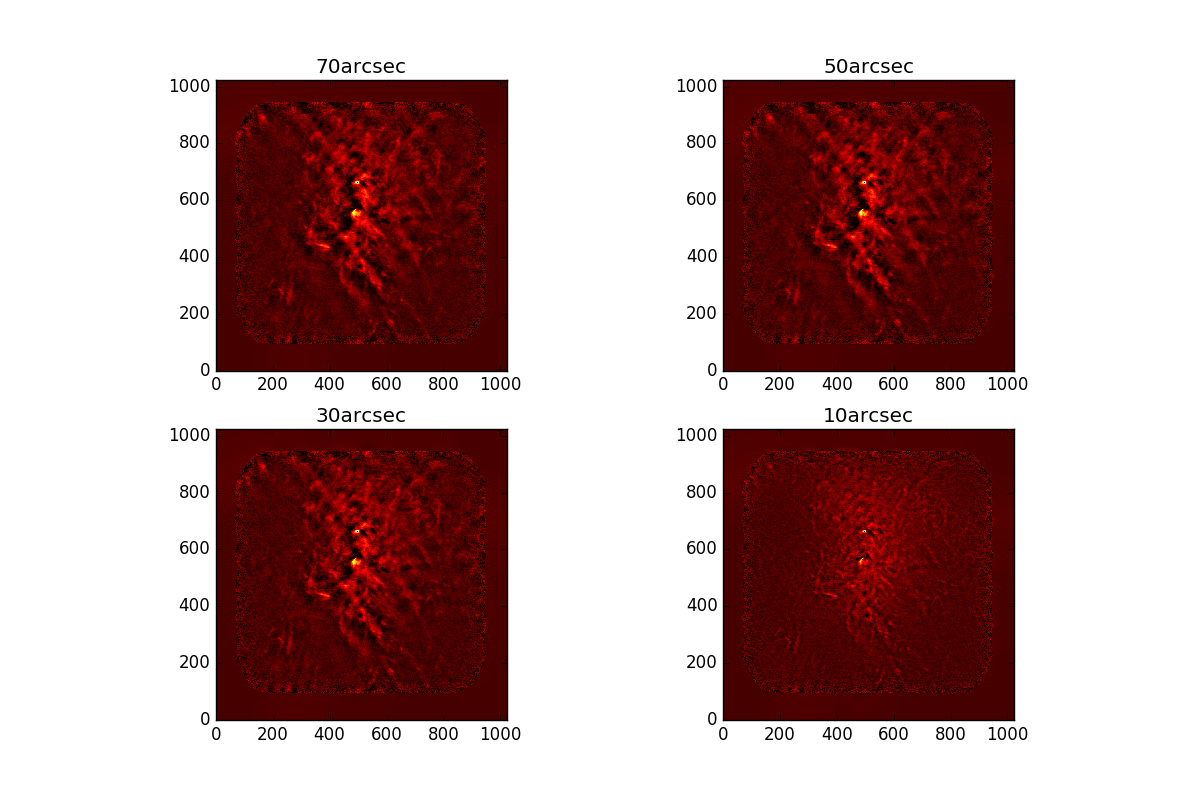
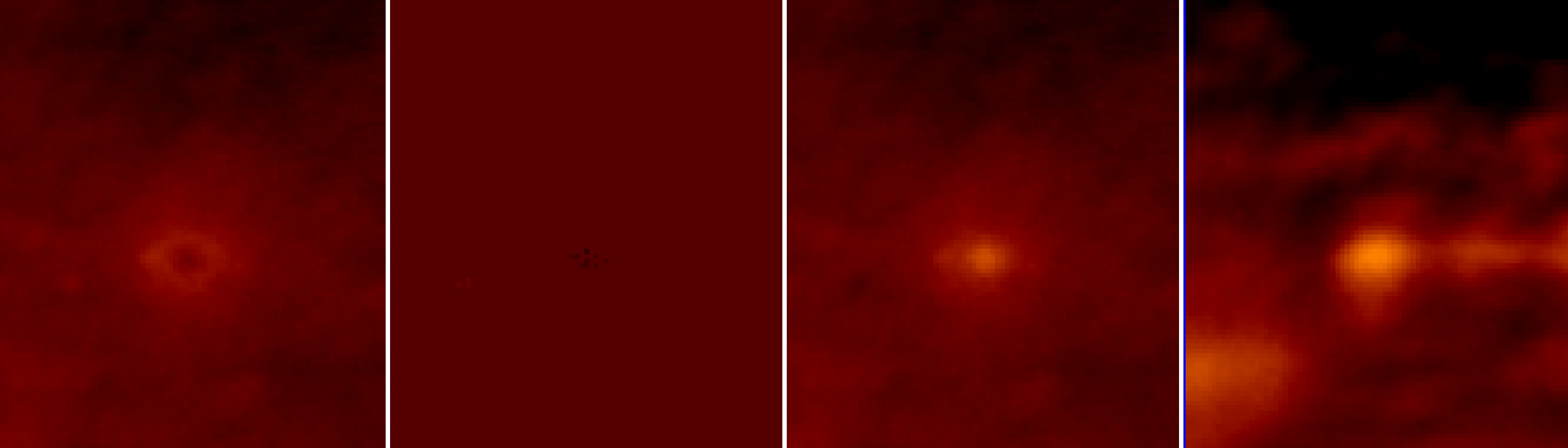
This is an examination of the 'feather' task in CASA.
First we have to track down what code is actually called.
On mac, this is:
- /Applications/CASA.app/Contents/Resources/python/feather_cli.py -> feather_cli
- /Applications/CASA.app/Contents/Resources/python/task_feather.py -> feather
- /Applications/CASA.app/Contents/Resources/python/taskinit.py -> imtool->imager->casac.imager->/Applications/CASA.app/Contents/Resources/python/feather_cli.py
- Imager.cc
Within the imager, setvp is used to do something with the primary beam. As
far as I can tell, this function spews a lot of text into the logger, sets
local variables, sets one larger-scope variable BeamSquint::, then does
destroySkyEquation();. In short, I don't know what this does. Probably my
reading of the C code is incorrect and these variables are not local, in
which case it is just setting a bunch of default beam parameters.
Then, Imager.cc calls Feather.cc.
Feather sets parameters based on the effective dish diameter. It uses
1.22*(speed of light)/frequency/dish_diameter,
so it is retrieving the FWHM
assuming a Gaussian beam by default.
A lovely aside: Imager.cc passes the local variable lowPassFilterSD
to Feather.cc, which is read in to the input boolean parameter
doHiPassFilterOnSD.
That seems like a potential place for confusion.
If doHiPassFilterOnSD is set or the effective beam diameter is set as a
parameter, the single dish image is deconvolved with its beam using the
GaussianDeconvolver. This is actually disabled by default, though.
The low resolution image is regridded
to match the high resolution image.
The applyFeather
command seems to do the actual work.
It starts with calcCWeightImage,
which sets the "weight" to one minus the peak-normalized fourier transform of
the low-resolution (single-dish) beam
Feather.cc line 427,
with the result stored in the variable cwImage_p.
applyFeather then just
multiplies the high-resolution image by this weight.
Back in the saveFeatheredImage
task, the single-dish data are fourier transformed, then a scaling factor, the ratio
between the low and high beam areas, is computed. Finally, the single-dish
(scaled) and interferometer fourier-transformed images are added.
Is the single-dish image weighted by the beam at all? The single-dish image will
be convolved with a kernel only if doHighPassFilterOnSD is set
or if the effective dish diameter is set. If the beam is the same size as the original
beam, nothing will happen.
In setEffectiveDishDiam
the low-resolution image is convolved with the *deconvolved*
beam.
The most important note in this post is that the single-dish image is not
weighted unless doHighPassFilterOnSD is set, and even then nothing will be
done if the single-dish beam size passed as a parameter is the same as the beam
size specified in the header. That means only the interferometer image is
weighted. Maybe that is the correct behavior? By weighting by (1-convolved
beam), which means setting the total flux in the interferometer image to zero,
the process is guaranteed to be flux conserving.